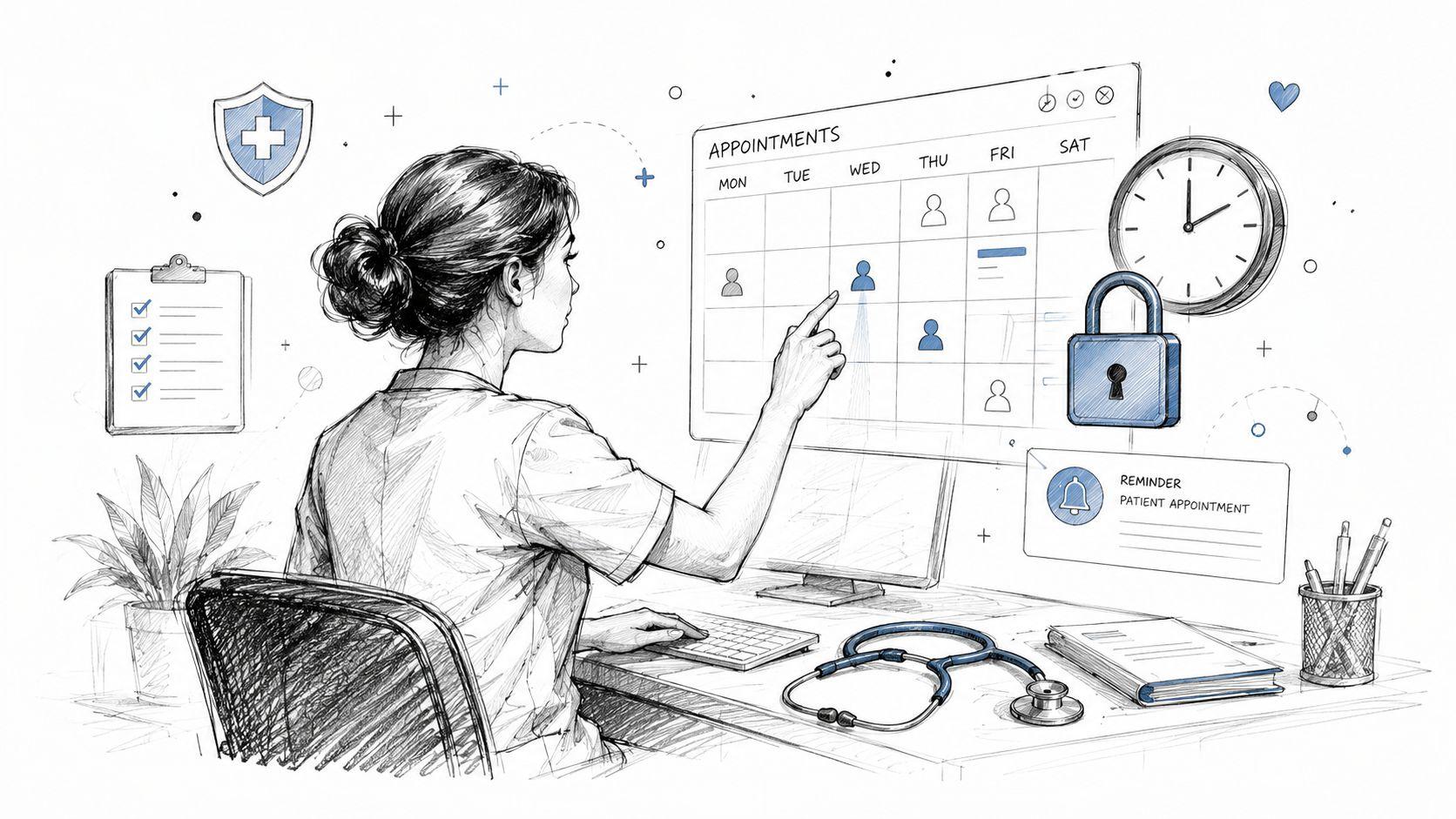

Scheduling Patients Appointments: 2026 Best Practices
The most popular advice about scheduling patients appointments is also the most incomplete: put a booking widget on the website, offer online self-scheduling, and the access problem is solved.
It isn't.
A portal helps, but a portal alone doesn't manage triage, protect official communication channels, absorb staff callouts, or keep one provider's calendar from becoming the bottleneck for an entire service line. In many organizations, the booking interface looks modern while the operating model behind it is still fragile. Staff still pass messages manually. Patients still chase specific clinicians. Managers still rebuild the day by hand when coverage changes.
That mismatch matters because scheduling sits at the front of access, revenue, and patient trust. When the workflow is weak, patients wait too long, staff spend their day repairing avoidable errors, and open slots appear at exactly the wrong time.
Beyond the Portal Rethinking Patient Appointment Scheduling
Online self-scheduling is useful. It is also one of the most overrated fixes in healthcare operations.
Patients do want digital access, but scheduling failure usually starts behind the screen. A primary weakness is the way many organizations still build access around a single clinician's calendar instead of a shared service model. The result is predictable. One provider gets overloaded, another has stranded capacity, and the front desk spends the day patching holes after callouts, urgent add-ons, and misrouted requests.
That approach breaks faster than many leaders admit. The American Medical Association reports that medical practices continue to face staffing instability and turnover pressure, which makes rigid, person-by-person scheduling harder to maintain under normal operating conditions, let alone during surges or absences (AMA physician practice insights). A portal cannot solve that by itself.
A schedule needs to reflect team capacity, license rules, room constraints, and fallback coverage. It also needs controlled communication paths so appointment changes, clinical follow-up, and patient questions do not end up scattered across unsecured texts, personal inboxes, and voicemail chains. In practice, the booking tool is only the front door. The operating model behind it determines whether access stays stable by noon.
I have seen clinics with polished portals still rely on manual reassignments every time one MA calls out or one physician runs behind. That is not a technology gap. It is a design gap.
The better model schedules for capability first. Patients are matched to the qualified team, visit type, and care setting that fit the request, then assigned to the best available clinician or staff member within that structure. That gives managers room to absorb same-day demand, re-route work safely, and keep private staffing details out of public view.
Teams reviewing strategic patient scheduling software should test for more than online booking. Check whether the system supports pooled scheduling, rule-based assignment, coverage fallback, role-based permissions, and secure communication that stays inside approved channels. Pretty calendars help with adoption. Resilient scheduling protects access, staff time, and patient trust when the day goes sideways.
Designing Your Intake and Triage Workflow
A scheduling system breaks long before the calendar fills up. It breaks at intake, when vague requests, inconsistent screening, and provider-specific booking habits send the wrong patients into the wrong slots.
That matters even more when new patient access is already strained. A recent survey on physician appointment wait times in major U.S. metro areas found that waits for a new patient visit remain long across many specialties and markets. In that environment, every misrouted request consumes scarce capacity twice: once when it takes a slot that should have gone elsewhere, and again when staff have to unwind the mistake.
Start with routing rules, not provider names
The intake workflow should classify the request before it shows availability. That means asking a short set of questions tied to operations and clinical fit, not patient preference alone.
- Is the patient new or established
- What is the visit type
- How urgent is the request
- Does the visit require a specific license, specialty, room, or device
- Can the visit be virtual, in person, or either
These questions prevent a large share of avoidable scheduling errors. New patient consults need different timing, documentation, and verification steps than follow-ups. Medication reviews should not consume procedure time. Same-day concerns need a protected intake path with staff oversight, not a race for the next visible opening.
The team should build routing around capability groups, not individual calendars. Clinics that still run scheduling straight from provider calendars often end up with brittle handoffs and hidden bottlenecks. If your current setup still depends on a single person manually sorting requests in a basic calendar tool, it helps to review where a Google Calendar appointment scheduler works and where it falls short for shared clinical workflows.
A practical triage model routes to capabilities such as:
- New patient consultation: reserve the longer workflow, insurance verification path, and pre-visit paperwork set needed for first visits.
- Established follow-up: use a shorter template and connect it to the care team qualified for ongoing management.
- Urgent same-day evaluation: send requests to a protected access lane with clear internal rules for escalation and callback timing.
- Procedure or resource-dependent visit: hold the matching equipment, room type, and support staff before showing times.
Separate intake pathways for common scenarios
New and established patients should not move through the same intake lane. Their documentation burden, booking risk, and scheduling options differ.
A practical model looks like this:
| Patient scenario | Intake focus | Scheduling rule |
|---|---|---|
| New patient | eligibility, history forms, reason for visit | route to new-patient capability before showing times |
| Established patient | symptom or follow-up reason | map to known care pathway and preferred care team |
| Same-day concern | urgency screening | escalate to protected urgent queue |
| Procedure request | prep instructions and resource match | schedule only where room, staff, and time fit |
That structure reduces front-desk guesswork. It also protects staff from constant exception handling because the system carries more of the decision logic upfront.

Build triage decisions into the booking path
Too many practices still treat triage as an individual staff skill. That creates uneven outcomes. One scheduler asks the right follow-up questions. Another books whatever fits because the queue is backing up. The result is predictable: rework, frustrated clinicians, and patients who receive conflicting instructions.
The safer approach is to build triage into the booking path itself.
- Use controlled visit categories: keep the patient-facing options short and plain-language. Keep the internal routing logic behind the scenes.
- Require minimal but decisive inputs: reason for visit, patient status, urgency, and modality preference usually identify the right path without forcing a long form upfront.
- Gate high-risk or unclear requests: if the request does not match a safe scheduling rule, stop self-booking and route it to staff review through approved channels.
- Attach the right prep automatically: once the visit type is confirmed, send the correct forms, instructions, and prerequisites without relying on memory or side messages.
Practical rule: If staff repeatedly correct appointments after they are booked, the triage design is failing. The system is pushing decisions downstream instead of handling them at intake.
Every intake workflow also needs an exception lane. Some requests will not fit a standard rule set, and forcing them into the nearest open slot usually creates more work for clinical staff later. A resilient team-based scheduling system accepts that exceptions exist, assigns ownership for review, and keeps communication inside secure workflows rather than personal texts, hallway conversations, or voicemail chains.
Good scheduling starts there. Intake decides whether the rest of the day runs on purpose or on cleanup.
Optimizing the Booking Experience and Automation
A good booking experience is not built by exposing a provider calendar and hoping patients choose correctly. It is built by controlling how approved demand reaches available capacity, then automating every secure step that follows.
That distinction matters in practice. Teams do not need a prettier front door if staff still spend the afternoon fixing visit types, chasing forms, and sending one-off updates after the appointment is already on the books. The booking layer should reduce rework, protect scheduling rules, and spread workload across the team instead of tying access to one person's calendar.
Research from the MGMA on online patient scheduling notes growing adoption of self-scheduling because it reduces call volume and gives patients after-hours access. The operational value is real, but only when self-scheduling is tied to controlled inventory, current rules, and secure communication.
What automation should handle after the slot is booked
Patients should not need to wonder whether the appointment is real, what they need to do next, or who to contact if something changes. Staff should not need to remember each follow-up step by hand.
A booking system works better when it automatically sends:
- Immediate confirmation: appointment time, visit type, clinician or team, location, and virtual access details if applicable.
- Required forms and consents: sent through approved channels with completion tracked inside the workflow.
- Visit-specific instructions: prep details, medication guidance, arrival timing, device requirements, or lab prerequisites.
- Action-based reminders: messages that let patients confirm, cancel, or request a change without starting a phone tag loop.
- Change notifications: updated instructions and timing whenever the slot, room, modality, or assigned staff member changes.
This protects staff time, but the bigger gain is consistency. Every patient gets the same next-step guidance, and every change stays inside the official communication path.
Generic booking links create avoidable risk
Reusable public booking links are convenient for staff and sloppy for healthcare operations. They get forwarded, bookmarked, reused months later, and detached from the screening context that made the original booking safe.
The result is predictable. Patients book into outdated visit categories. Staff discover too late that the request should have gone to a different pool, a different modality, or a review queue. If the organization relies on personal workarounds to sort that out, the system is already failing.
That limitation is easy to see in tools built around simple availability display, including workflows like Google Calendar appointment scheduling. Those tools can show open time. Healthcare scheduling usually needs more than open time. It needs controlled access, team fallback, and message handling that stays inside approved systems.
Secure booking should be session-based and rule-based. Permanent public doors to calendars create cleanup work and unnecessary exposure.
Build automation around team capacity, not one calendar
The strongest setup routes patients into a managed pool of capacity first, then assigns the work to the right clinician, room, device, or staff member based on current availability. That gives the schedule room to absorb callouts, overruns, cross-coverage, and urgent add-ons without forcing a full reschedule.
In other words, automation should support operational resilience, not just convenience.
A stronger booking design usually looks like this:
| Scheduling area | Weak setup | Strong setup |
|---|---|---|
| Availability | one provider's exposed calendar | pooled capacity with assignment rules |
| Access | reusable public booking link | expiring or session-based booking path |
| Visit selection | broad patient-facing menu | pre-mapped appointment type from approved workflow |
| Staffing changes | manual reassignment | fallback rules for alternate staff or locations |
| Communication | separate calls, texts, and inboxes | automated updates through secure approved channels |
One more point is often missed. Automation should help fill appointments, but it should also support recovery when the day changes. Teams that want better retention and solutions for tackling no-shows should choose systems that can trigger fast, controlled outreach when patients confirm, cancel, or need to be moved.
The standard is simple. If the software only makes booking easier for the patient but harder for the team, it is not improving scheduling. It is shifting operational risk downstream.
Managing No-Shows and Last-Minute Changes
No-shows are usually blamed on patient behavior. In practice, they expose weak scheduling operations.
A fragile clinic treats every broken appointment as an isolated incident. A resilient clinic treats it as a capacity event, then routes the opening through a controlled recovery process. That difference matters because the financial and staffing impact is real. Dialog Health's overview of patient appointment scheduling notes the scale of no-show losses in U.S. healthcare, the growing use of predictive models, and the relationship between longer scheduling horizons and missed visits. The lesson is straightforward. Teams need fewer empty slots, faster backfill, and less manual chasing by front-desk staff.
Prevention starts with reducing avoidable drop-off
Reminder volume is not the goal. Reliable attendance usually comes from reducing friction at the points where patients hesitate, forget, or decide the visit is no longer worth the effort.
That means building a prevention process with clear decision points:
- Use confirmation messages that require a response. A patient should be able to confirm, cancel, or request a change without making a separate call.
- Set cancellation rules that staff can enforce consistently. If the policy exists only on paper, it will not change behavior.
- Assign pre-visit tasks before the appointment date. Forms, medication instructions, and prep steps create a real checkpoint that surfaces problems early.
- Keep clinically appropriate appointments closer to the booking date. Long lead times create more opportunities for patients to disengage or seek care elsewhere.
- Flag higher-risk visits for human follow-up. New patients, complex prep visits, transportation barriers, and repeated no-shows should not all get the same workflow.
This is also where secure communication matters. A text reminder is useful only if the reply can enter the scheduling workflow safely, reach the right queue, and trigger the next action without exposing protected information through ad hoc channels.

Recovery has to be team-based
Same-day gaps will still happen. The question is whether staff have a reliable way to fill them without stopping everything else.
The better model is a rules-based waitlist tied to appointment type, patient preferences, location, payer constraints, and who on the team can absorb the visit. Manual callback lists break down fast once a physician runs late, a nurse calls out, or a room goes offline. A team-based recovery process handles those changes without rebuilding the day from scratch.
For teams reviewing staffing dependencies alongside access issues, this guide to nursing scheduling software for healthcare teams is a useful complement. It helps frame the staffing side of last-minute recovery, especially when schedule changes involve cross-coverage rather than a simple patient swap.
For teams that want a practical overview of outreach tactics, solutions for tackling no-shows can help frame the reminder and rebooking side of the problem. The value comes when those tactics are connected to real scheduling rules, not handled as a separate, concluding cleanup task.
Structured buffers outperform wishful scheduling
Many clinics try to solve no-shows and late cancellations by packing the calendar tighter. That usually creates a second problem. Once a few patients arrive late or a visit runs long, the entire session slips.
A better daily design uses controlled buffers, limited same-day release slots, and small arrival waves where the care model supports them. This gives staff room to re-sequence the session, bring forward a waiting patient, or shift work across the team without creating a lobby backlog. It also protects clinicians from constant context switching, which is one of the hidden costs of aggressive overbooking.
I have seen this work best when managers stop asking, "How do we keep every provider full?" and start asking, "How do we keep the service line stable when the day changes at 9:15?" That shift produces better decisions. It leads to reserve capacity, clearer fallback assignments, and faster outreach through approved channels.
The practical standard is simple. Prevent the avoidable no-show. Recover the unavoidable opening quickly. Do both with secure messaging, pooled staff options, and rules the whole team can follow under pressure.
Building a Resilient Staff and Resource Schedule
The weakest healthcare schedules are built on a hidden assumption: the patient should be attached to a person as early as possible.
That assumption causes trouble. It encourages patients to chase named clinicians when the actual need is a service capability. It forces managers to reshuffle the day whenever shifts change. It also exposes too much of the system's internal staffing logic to the outside world.
Research on scheduling practice has pointed to this gap directly. Existing guidance focuses heavily on individual calendars, while capability-based, multi-agent scheduling for rotating shifts or sick calls remains underserved. Few solutions handle multi-tier fallback logic well enough to reroute patients automatically when a provider becomes unavailable, as discussed in Phreesia's patient scheduling best practices.
Schedule the capability first
The better model is to define schedulable units around what the team can deliver, not around who happens to be on duty at the moment of booking.
Examples include:
- Post-op follow-up team
- New patient intake team
- Diabetes education capability
- Behavioral health callback pool
- Nurse-led triage visits
That doesn't erase clinician qualifications. It organizes them correctly. The patient gets routed to the right care lane first. The system then applies the staffing rules needed to fulfill that visit safely.

Fallback logic prevents schedule collapse
When scheduling is person-centric, an absence creates a chain reaction. Staff call patients, supervisors search for coverage, and patients lose confidence because the process looks brittle.
A capability model uses fallback tiers instead. One useful pattern looks like this:
| Scheduling layer | Purpose |
|---|---|
| Primary pool | preferred team for that visit type |
| Secondary pool | qualified backup staff within the same service |
| Escalation pool | designated overflow or supervisory coverage |
| Manual review queue | exceptions that need clinical or operational judgment |
That logic is more realistic than pretending every booking can stay attached to one named person from the start. It also protects continuity when vacations, shift swaps, and sick calls hit.
For organizations thinking through workforce configuration, tools discussed in nursing scheduling software workflows are useful because nursing operations have dealt with pooled coverage and skill-based assignment for years. The same principles apply to ambulatory scheduling. Match by competence, credential, and current capacity before locking in a specific individual.
Use just-in-time assignment where appropriate
Some visits do require advance assignment. Many don't.
For routine follow-ups, nurse visits, callbacks, support-based clinical navigation, and other pooled services, just-in-time assignment is often the cleaner choice. The appointment is accepted into the right capability lane, but the specific staff member is chosen closer to the visit based on who is available, qualified, and balanced for workload.
That approach solves several recurring problems at once:
- It reduces unnecessary reassignments because the system waits until staffing reality is clearer.
- It protects privacy and channel control because direct staff contact details don't have to circulate widely.
- It balances work better across teams that share responsibility for the same service line.
Team-based scheduling isn't less personal. It's more dependable.
Patients care about access, clarity, and competent care. They usually don't benefit from inheriting the internal fragility of an organization's staffing model. A resilient schedule should absorb staff variation quietly. If patients constantly feel the turbulence, the system is overexposing individual calendars and underusing team capacity.
Integrating Systems and Measuring Success
A scheduling system breaks down fast when it sits outside the rest of operations. If the booking tool, EHR, reminders, staff calendars, and reporting all keep different records, the team spends the day reconciling conflicts instead of serving patients. Patients see the downstream effect as duplicate messages, incorrect arrival times, missed follow-ups, and avoidable reschedules.
Integration matters because scheduling is not a single event. It is a chain of handoffs across front desk staff, clinical teams, rooms, devices, and patient communications. In a team-based model, those handoffs multiply. That is why shared rules, synchronized status changes, and controlled communication paths matter more than a polished portal.

What integration must handle
Start with the operational moments that fail first when systems are disconnected.
- Appointment creation: the booking should post to the clinical record without duplicate entry or manual re-keying.
- Reschedule and cancellation updates: status changes need to appear quickly across scheduling, reminders, and any resource calendars.
- Follow-up triggers: after the visit, the next scheduling step should route to the correct queue, team, or visit type without relying on memory.
- Resource coordination: rooms, equipment, modality, interpreter needs, and staffing rules should match the appointment before it is confirmed.
- Communication logs: reminders, confirmations, and patient replies should be visible to the staff responsible for the next action.
The weak point in many clinics is calendar sprawl. A provider calendar says one thing, a room calendar says another, and a support team has a third version in email or chat. The practical lesson behind workflows for merging Google Calendars is simple. Fragmented availability creates blind spots quickly. In healthcare, those blind spots affect privacy, staffing fallback, and patient trust, not just convenience.
Five metrics worth tracking
Scheduling dashboards often track too much and explain too little. Use a short set of measures that show whether the system is protecting access, staff time, and continuity of care.
-
Third next available appointment
This is a better access measure than the next open slot because it filters out one-off cancellations and odd gaps. -
No-show rate by visit type and lead time
A single no-show rate obscures the underlying pattern. Break it down so the team can see where confirmation timing, visit preparation, or booking rules need work. -
Administrative time per booking
This shows whether automation is removing effort or just shifting work from one team to another. -
Team utilization by service line
Individual provider utilization can mislead in pooled models. Team-level views show whether shared capacity, fallback coverage, and skill mix are aligned with demand. -
Follow-up completion reliability
If clinically necessary follow-ups are ordered but not booked, or booked but frequently abandoned, the scheduling system is weakening care continuity.
Source tracking belongs in this group too. Multi-channel scheduling only improves operations if leaders know which channels generate the right demand, at the right times, for the right services. For teams that need to understand lead origins in Zoho Bookings, that reporting discipline helps with staffing plans, referral management, and access planning.
Measurement takes work. It also exposes uncomfortable truths. Teams often discover that poor access is not one provider's problem. It is usually a rule problem, a routing problem, or an integration problem that pushes avoidable work back onto staff. Track that accurately, and scheduling becomes easier to improve because the team is fixing the system instead of blaming the calendar.